Posts

Always Expect Worse: Overpowering Downdraft, Strong Headwind, Low Fuel, System Failure

Image
Sandia Mountains viewed from the west. Credit: Reduced version of photo by Dicklyon - Own work, CC BY-SA 4.0 If Murphy had been knowledgeable about aviation, he would have strengthened his law and said: "It will go wrong." All of the bad events described below happened during just one trip from Dallas to Flagstaff, AZ and back. Overpowering Downdraft We are en route from Dallas to Albuquerque, NM. After a refueling stop in Plainview in the Texas panhandle, we encounter a strong headwind. We try to minimize the effect by flying 1,000 ft AGL (above ground level).  The wind becomes stronger as we approach the Sandia Mountains near Albuquerque. See the above photo, which shows the mountains from the west.  We need to climb at least to 2,000 ft AGL to avoid mountain-induced turbulence. Due to the headwind, we make little forward progress, while the headwind cascading down the east side of the mountain pushes us down. We have never seen such a strong combined effect during our nume...

IFR/VFR Conflicts in Magenta Areas

Image
  Magenta area with MVFR airport West Texas loves low ceilings in the morning, an amazing fact when you consider that this is desert country. A notable exception is the Pecos airport, which evidently has a secret contract with the weather gods for unlimited ceiling and visibility year round. We plan accordingly. When we go west from Dallas, we carefully monitor the ceiling of our preferred refueling stop, the uncontrolled airport Andrews in the Midland/Odessa area. Andrews almost always has ceilings of less than 500 ft in the morning. If the ceiling lifts to at least 1,000 ft by the time we get there, we land and refuel. If that fails, we detour to Pecos, which invariably is VFR. Andrews is surrounded by a magenta boundary. It means that within that area one may fly up to 700 ft AGL while staying clear of clouds, provided visibility is at least one mile.  So why wouldn't we land at Andrews if the ceiling was at least 700 ft, instead of demanding at least 1,000 ft? We could sim...

The Invisible Threat of Wind Turbines

Image
Field of wind turbines. Photo by Waldemar Brandt on Unsplash West Texas has huge swaths of land covered with ever-larger wind turbines.  These turbines are a significant threat to aviation, as has been established in several studies of turbulence and visibility. The threat will grow as turbines become ever larger. The latest development is a turbine by General Electric with a 850 ft (260 m) tall tower and 350 ft (107 m) long blades that will likely show up in Texas some time in the future.  There are two problems for pilots: The blades are difficult to see from the air, and they produce significant turbulence downstream. While the turbulence of single turbines has been studied in detail, little is known about the effect of an entire field of turbines. Here is a demonstration that fields of turbines can create powerful turbulence. Below is a screen shot of a Garmin Pilot map taken on May 29, 2021 when we were planning a flight from Dallas to Albuquerque, NM. It shows a fi...

Tire Changes for Zenith Aircraft

Image
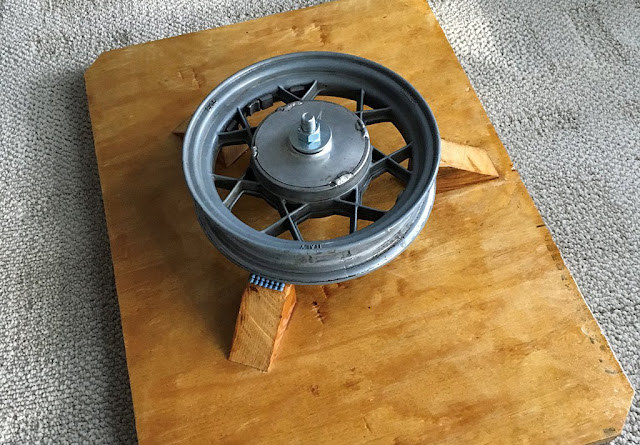
Fixture with mounted rim Several Zenith aircraft have wheels with one-piece rims. Changing the tire of such a wheel is difficult, since t here is no easy way to clamp down the rim.  We have that case for the 8 in. wheels of our Zenith 601HDS, where the rim has delicate cast spokes.  This post describes a fixture that makes the task easy. It holds the wheel in place while we remove  or install the tire with two spoons. Fixture for holding wheel Here are the steps for making the fixture. Platform Use 3/4 in. plywood. Make the piece large enough  so that you can hold it down with your feet or knees. Three Support Blocks Cut three triangular support blocks shown in the above photo from a short 2x4 piece. Attach  them to the platform from below with one drywall screw each. Glue a patch of rubber shelving material on top of each support block. The soft material assures that the blocks do not scratch the paint of the rim. Center Bolt and Spacers ...

Rotax 912 Engine: 2,500 Hours in 29 Years (achieved in 2024)

Image
Rotax 912 engine The  Rotax 912 engine  in o ur plane, a Zenith 601HDS, has reached an important milestone. Over the past 29 years, it has run 2,500 hrs without major repairs. Zenith 601HDL, N314LB It's appropriate to reflect about this performance and muse how this is possible. After all, when we bought the engine, in 1994, the suggested TBO was 1,200 hrs.  Since then TBO has gone up, first to 1,600 hrs, and more recently to 2,000 hrs. Of course, those increases apply to later engines, not to our early model. Let's see how the engine performs after all this time. Want to learn more about flying?    My book Lessons from Piloting for 45 Years  covers close shaves over more than four decades involving thunderstorms, mountain weather, faulty runways, equipment failures, and more. Learn key strategies for coping with these dangerous situations.  They include two tools called Sully's Rule and Forecast Evaluation. Performance afte...